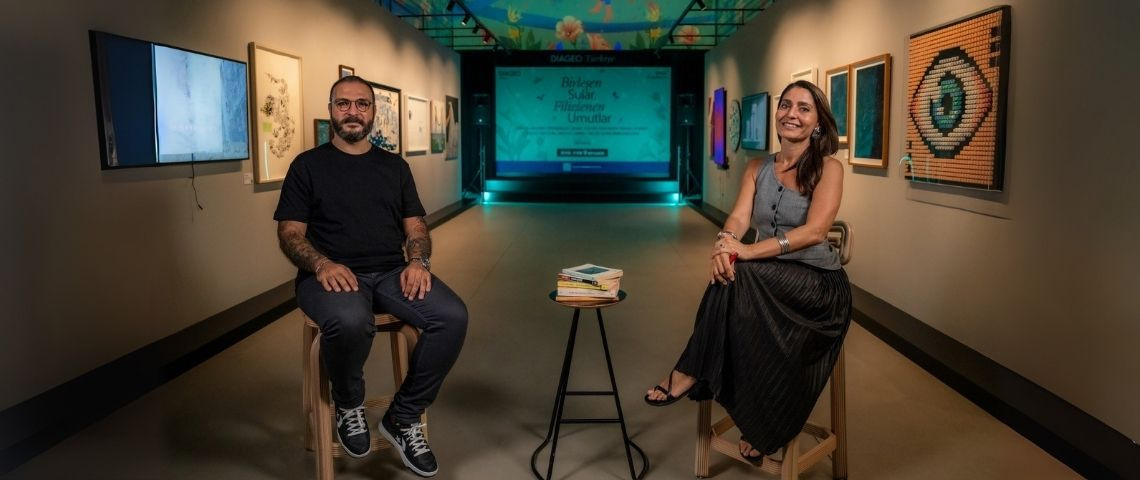
In the 16th episode of Art Niyetli Sohbetler, we met with the curator of the exhibition Sinan Eren Erk at Hope Alkazar for Diageo Turkey's first exhibition, "Converging Waters, Blossoming Hopes." We talked about many topics, from the conceptual process of the exhibition to the role of nature and hope during the pandemic, the urban layers of Istanbul, and the function of art today. Here it is.
The name of the exhibition is "Converging Waters, Blossoming Hopes." First of all, I want to learn how you came together with Diageo Turkey. Then we can dive into the exhibition.
Actually, this project was something previously considered for Diageo Turkey. They contacted me, and we talked about what we could do together. This process was spent both getting to know each other and seeking an answer to the question of what kind of exhibition could emerge. They had a vision of how they could contribute to the field of contemporary art in Turkey, and within the framework of this vision, we started talking about names and ideas. The process took shape gradually and emerged in connection with the title of the exhibition.
You mentioned Diageo Turkey's vision here. As Plumemag, we always advocate that sustainability cannot be handled independently of culture, art, and aesthetic philosophy. We have had collaborations with Diageo Turkey for many years, and we see closely how they support art in Turkey. This project is also important in terms of them working with you in an initiative started under their own leadership for the first time. Before the exhibition, I want to start with some quotes from the curator's text. When I first read the text, I noticed this: It is written in everyday Turkish, in a way everyone can understand, and in this context, can we say it contains a bit of small activism?
Certainly, thank you very much. Writing exhibition texts is not easy; although there are now tools like artificial intelligence, writing a text still requires finesse. I liken it a bit to writing poetry: first you take a large whole, then you simplify it and you need to convey it considering who you are telling it to. In my first exhibitions, there were very long, detailed texts. Later, I realized that communication with the visitor is very important; texts should be simple and understandable, and should open up space for discussion. This is the aim of the exhibition: to put forward an idea and ensure it is talked about. At the same time, it is about being able to stand behind the exhibition and making the works that artists have created over time visible.
I want to talk about the pandemic period. During this process, the fact that nature could renew itself rapidly and that we could watch this from our homes caught your interest. These observations are also included in your text. So, how do you read hope regarding this "captivity" experienced during this period and the unresponsiveness of the youth to it?
The pandemic was the intersection point of utopias and dystopias. Crises in history, such as wars and economic depressions, create waves like a drop thrown into water, and nature and humans try to balance them. Artists show hope again during times of crisis. Human nature does not accept hopelessness, and we observed this during this process. We learn to look outside, to sprout small seeds; hope is hidden in what nature teaches us.
You are configuring the exhibition in the context of Istanbul; the concept of the city and public space is important here. What context does the independence of the public space from the private and your layered approach to the city offer?
I wanted to treat Istanbul as a city that I have experienced over a long period. There is a narrative of the works in the exhibition moving along a corridor; it reflects the city metaphor with reciprocal narratives, motifs, and repetitions between the walls. The fact that people establish connections between their own small worlds and the big world matches the urban approach of the exhibition. Like the two sides of the Bosphorus, the works also establish a reciprocal relationship.
There are also references to literature, poetry, and cinema in your texts. What kind of experience do the layered approaches in this exhibition offer?
This approach aims to establish a bond between the city and history. Observing the nostalgic and layered structure of Istanbul is important in terms of making the visitor feel both the past and the present. The exhibition ensures that people learn through surprise and wonder; art assumes a role that sprouts hope.
Can we say that art has a preventive and protective effect in its function today?
Definitely. Art allows us to discover new ways by challenging our psychology and way of thinking. Observing dystopias and crises triggers the search for solutions. Humanity no longer progresses based on faith but on analysis thanks to science; parallel to this, art offers a practice of thinking and producing solutions.
Connecting the relationship between human and time through our different versions and traces is also one of the fundamental themes of the exhibition.
Yes. Humans change on the axis of time; we have different versions of ourselves in the past, today, and the future. Artists leave these traces with their works, and curators mediate in bringing these traces to light.
Who are the names you want to thank the most in the "Converging Waters, Blossoming Hopes" exhibition?
I would like to thank the artists; without them, the exhibition could not have been held. I also thank Diageo Turkey and all stakeholders for their coordination and support.
Until when can we visit the exhibition?
It will be open until October 27.
Finally, I want to appreciate the art and the effort. Thank you for this conversation and the exhibition.
I thank you as well. This exhibition and conversation offer a very valuable space to experience collective hope and solidarity.