
International research shows that although DEI (Diversity, Equity & Inclusion) investments have gained more acceptance worldwide in recent years, they have not reached the desired level in terms of implementation. According to data from organizations such as Forrester and McKinsey, a decrease in investments in this field has been observed in recent years. In Turkey, the concept of DEI is often reduced only to the "diversity" dimension, or even to a perspective limited solely to gender representation. However, a true transformation requires a holistic approach that also includes the principles of inclusion and equity.
According to Forrester's 2024 report, corporate DEI investments have decreased significantly in the last three years. While 33% of companies invested in this area in 2022, this rate dropped to 20% in 2024. This decline may lead to short-term pauses in employee experience and sense of belonging. In contrast, McKinsey’s 2023 "Diversity Matters Even More" report proves the strong link between diversity and financial success. Companies with the highest gender diversity in their management teams exhibit 39% higher financial performance compared to those with the lowest. In companies with high ethnic diversity, operational profitability is 24% above the sector average.
McKinsey's 2024 "Women in the Workplace" report reveals that women's representation in senior management has increased, but the "broken rung" obstacle persists. In 2024, the appointment of only 81 female managers for every 100 male manager appointments shows that women lag behind in promotion processes. The decrease in female representation as one moves up the hierarchy points to the weakness of corporate commitment and sponsorship mechanisms.
According to 2024 data from the World Economic Forum, Turkey has fallen to 135th place among 146 countries in the global gender equality index. OECD data confirms that the "glass ceiling" obstacle is still very strong in Turkey. While the labor force participation rate is 72% for men, it remains at the 36.8% level for women. Experts emphasize that the prerequisite for progress is confronting prejudices and handling diversity in a wide spectrum such as age, disability, ethnicity, and socio-economic background, not just gender.
Some institutions in Turkey are making a difference by taking concrete steps in this field:
Enerjisa Enerji: Supports female engineers with the "She-nergy" program and aims to exceed the legal quota in the employment of people with disabilities.
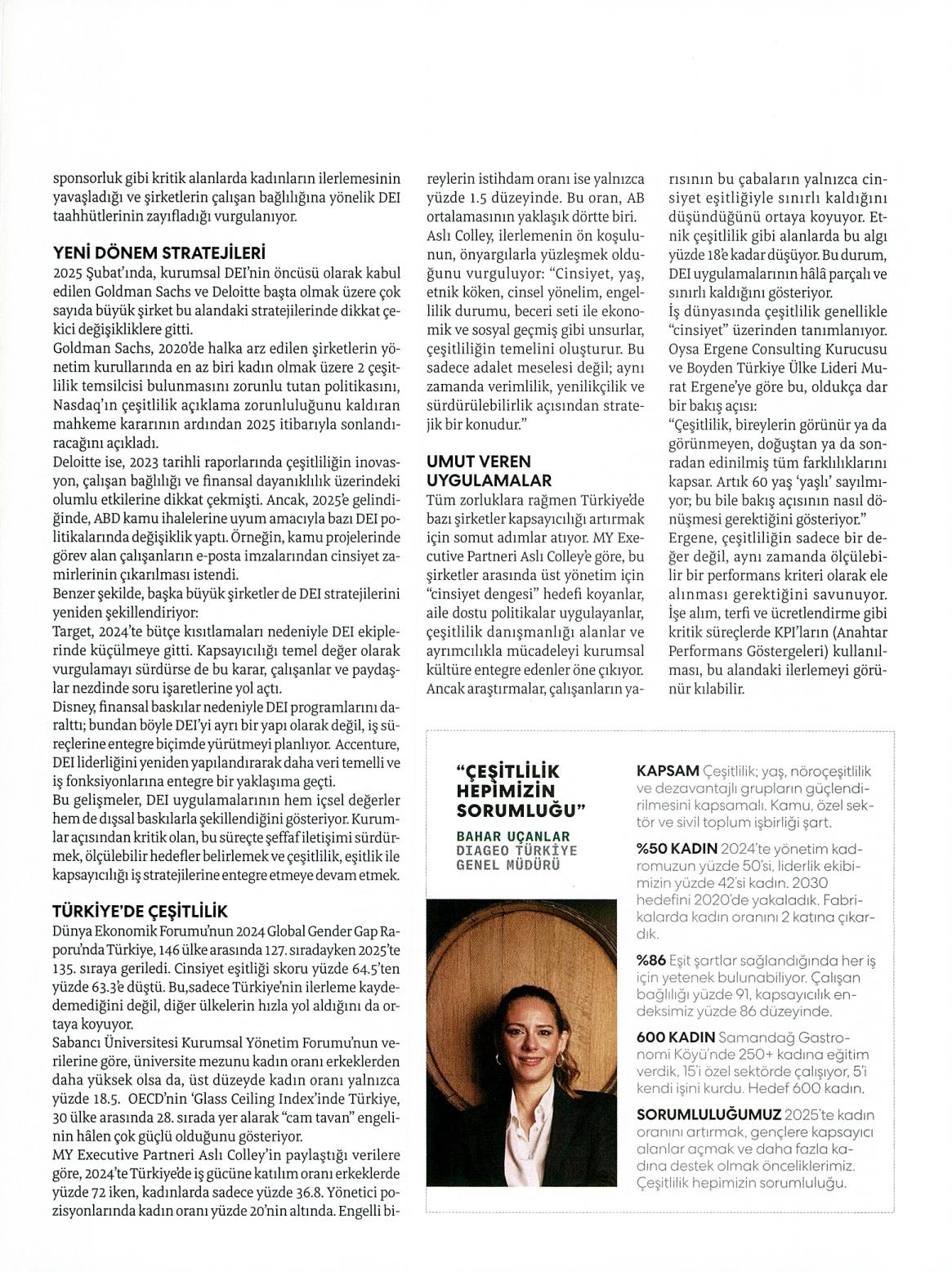
Diageo Turkey: While reaching a 50% female ratio in its management staff, it supports social development with projects such as the "Samandağ Gastronomi Köyü."
Boyner Group: Values collective wisdom in decision-making processes with 48% female representation in management levels and provides leadership training to young women with the "She Lab" program.
Allianz Turkey: Implements neutral recruitment processes such as anonymous resumes and photos-free CVs; audits wage equality with the "Equal Pay" system.
Vodafone Turkey: Offers a return opportunity to women who have taken a break from work life with the "ReConnect" program and transforms sexist expressions in language with the "Red Line" project.
MediaMarkt Turkey: While increasing the female ratio in store teams from 18% to 35%, it offers accessible solutions for visually impaired individuals through collaboration with BlindLook.
Garanti BBVA: Makes inclusivity a corporate culture with the Women Entrepreneur Program and the "TalentAccess" disability internship program.
A true DEI transformation should go beyond symbolic events and be handled as a strategic performance criterion. Data-driven approaches, transparent measurement systems, and inclusive leadership allow institutions not only to fulfill their social responsibilities but also to gain innovation and competitive power. Diversity, equity, and inclusion are not just a part of the modern business world; they are the cornerstone of a sustainable future.