
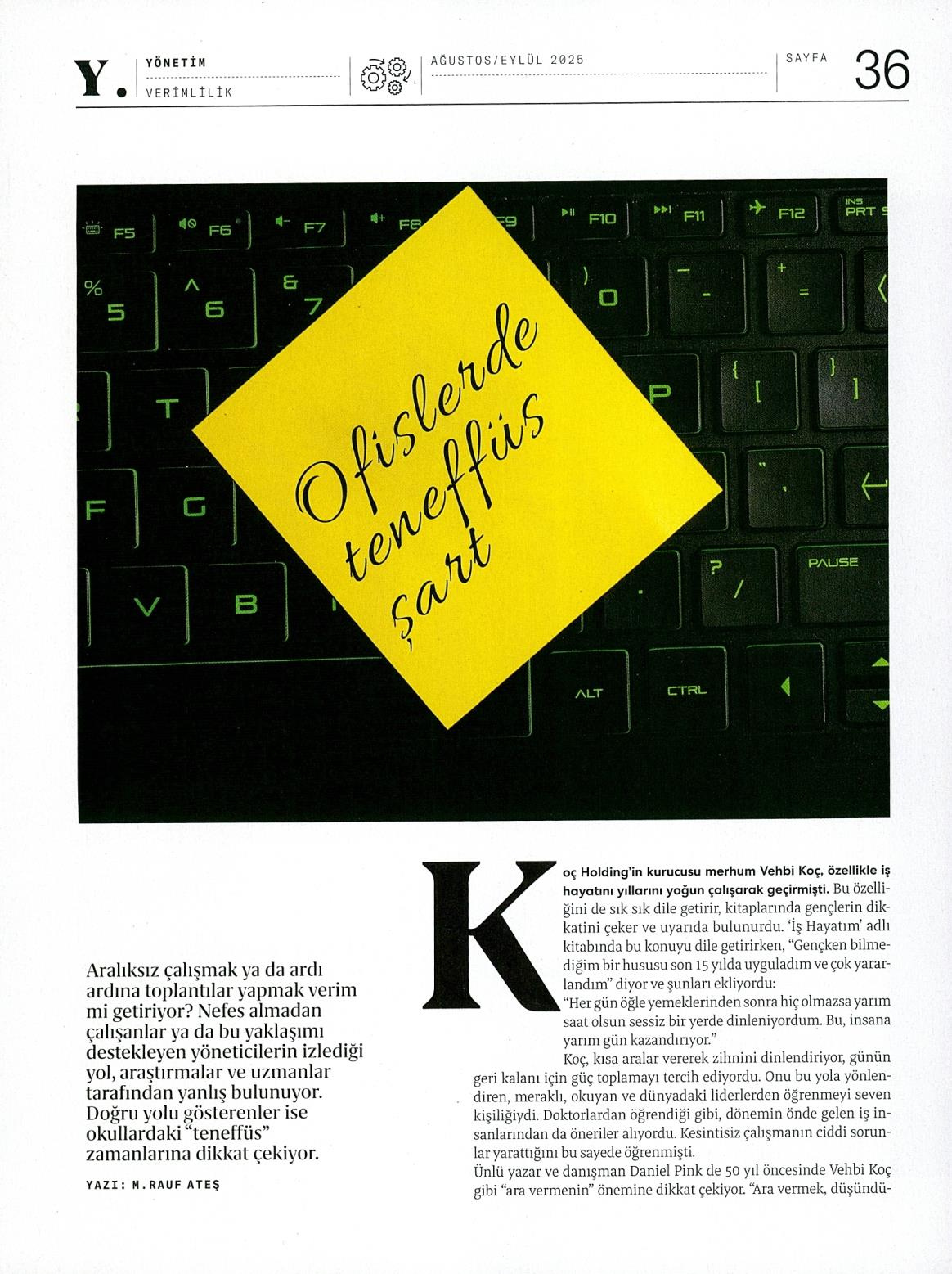
Does working non-stop or having back-to-back meetings bring productivity? The path followed by those who work without catching a breath, or managers who support this approach, is found to be incorrect by research and experts. Those pointing to the right path draw attention to "recess" times in schools.
The late Vehbi Koç, founder of Koç Holding, spent years of his business life working intensely. He frequently expressed this trait, drawing the attention of young people in his books and offering warnings. Addressing this issue in his book My Business Life, he says, "I applied a matter in the last 15 years that I did not know when I was young, and I benefited greatly," adding: "Every day after lunch, I would rest in a quiet place for at least half an hour. This gains a person half a day."
Koç preferred to rest his mind by taking short breaks to gather strength for the rest of the day. What directed him to this path was his curious, well-read personality that loved learning from world leaders. Just as he learned from doctors, he also received suggestions from leading business people of the period. In this way, he learned that continuous work creates serious problems.
Famous author and consultant Daniel Pink also draws attention to the importance of "taking a break," much like Vehbi Koç did 50 years ago. "Taking a break is much more powerful than we think," he says. According to him, even 1-2 minute "micro-breaks" strengthen focus and the mind. "If you include nature in this break, its effect becomes higher," he adds. Daniel Pink continues his suggestion with the words, "Do you want more?": "If you want to be supercharged, take the break with someone you love. Completely unplug, get rid of devices. For example, a 10-minute walk, getting completely away from work, would be very good. Moreover, it can have a great impact not only on the individual but also on the company."
According to research by the Draugiem Group, the most productive employees take a 17-minute break after every 52 minutes of work. The research reveals that these individuals are between 10-20 percent more productive than normal.
Hakan Aran, General Manager of İş Bankası, likens these breaks to school recesses: "Considering that the other meaning of the word 'recess' (teneffüs), which we have known since our school years and covers the act of taking a break, is 'respiration' (breathing), its vital importance also emerges. First of all, let me say this, I believe that taking a break increases the quality of life and definitely provides positive contributions to work outputs and efficiency. Well, how much can I take a break, and how much do I enable my colleagues to take a break?"
Aran then answers the question, "Is this a leadership method for you?": "If being able to start the day very early and do sports, sitting somewhere after work to chat, being able to listen to music, or having coffee chats in the middle of the day is 'taking a break,' then yes, I both take breaks and create opportunities for my colleagues to take breaks. The gyms we opened in our work centers, the after-work concerts at the end of the shift on Friday evenings, and the lunch coffee chats we have with our colleagues let us breathe and ensure we are refreshed."
The American Heart Association published a study revealing that inactivity in the office increases the risk of cardiovascular diseases. In this 2020 study, the following findings were included: "Standing up and taking a short walk every 30 minutes is good for health. It supports not only physical health but also mental health."
Eda Uluca Özcan, CEO of Pluxee Turkey, emphasizes the importance of "stopping for a short while within a tempo that intensifies from time to time": "I try to take a short break or move, even for 5 minutes. Sometimes, within a busy meeting agenda, I leave my room and chat with my teammates on a different subject. This both distracts me and rests me. When I return to the meeting, I feel that I approach the relevant subject more healthily."
16%: According to the University of Illinois, the attention level of those who take breaks is higher by this rate.
20%: According to MIT Sloan Management, the improvement rate in the decision quality of managers who take small breaks.
57%: According to Deloitte Human Capital, the burnout rate observed in managers who do not take breaks.
30-40%: According to Microsoft, the rate of increased mental load in employees who do not take breaks.
TIME WITH FAMILY: Being able to use our leaves with peace of mind and being able to spend weekends with our families without thinking about work are very precious breaks for intense workers like us. We know that running with a constant high tempo and high pulse is not sustainable.
INSPIRATION FROM ATHLETES: We sometimes need to take inspiration from very successful athletes who manage to rest even while running, and we need to succeed in recovering, becoming ready again, and increasing our energy levels by taking breaks for a few days or during the day in working life.
THE DIFFERENCE AT İŞ BANKASI: With short breaks provided; it is valuable to be refreshed, to return renewed, and sometimes to create an opportunity to evaluate what is happening differently with a perspective from a distance. I do not shy away from adding vitality to the team with surprise tasks, unexpected rotations, and experiments.
BREAKS ARE IMPORTANT: Taking short breaks is an important leadership method in terms of efficiency. In addition to individual performance, it also increases general team efficiency. For this reason, taking short breaks to be able to focus better and produce higher quality work is a good method; it gives a person a fresh perspective.
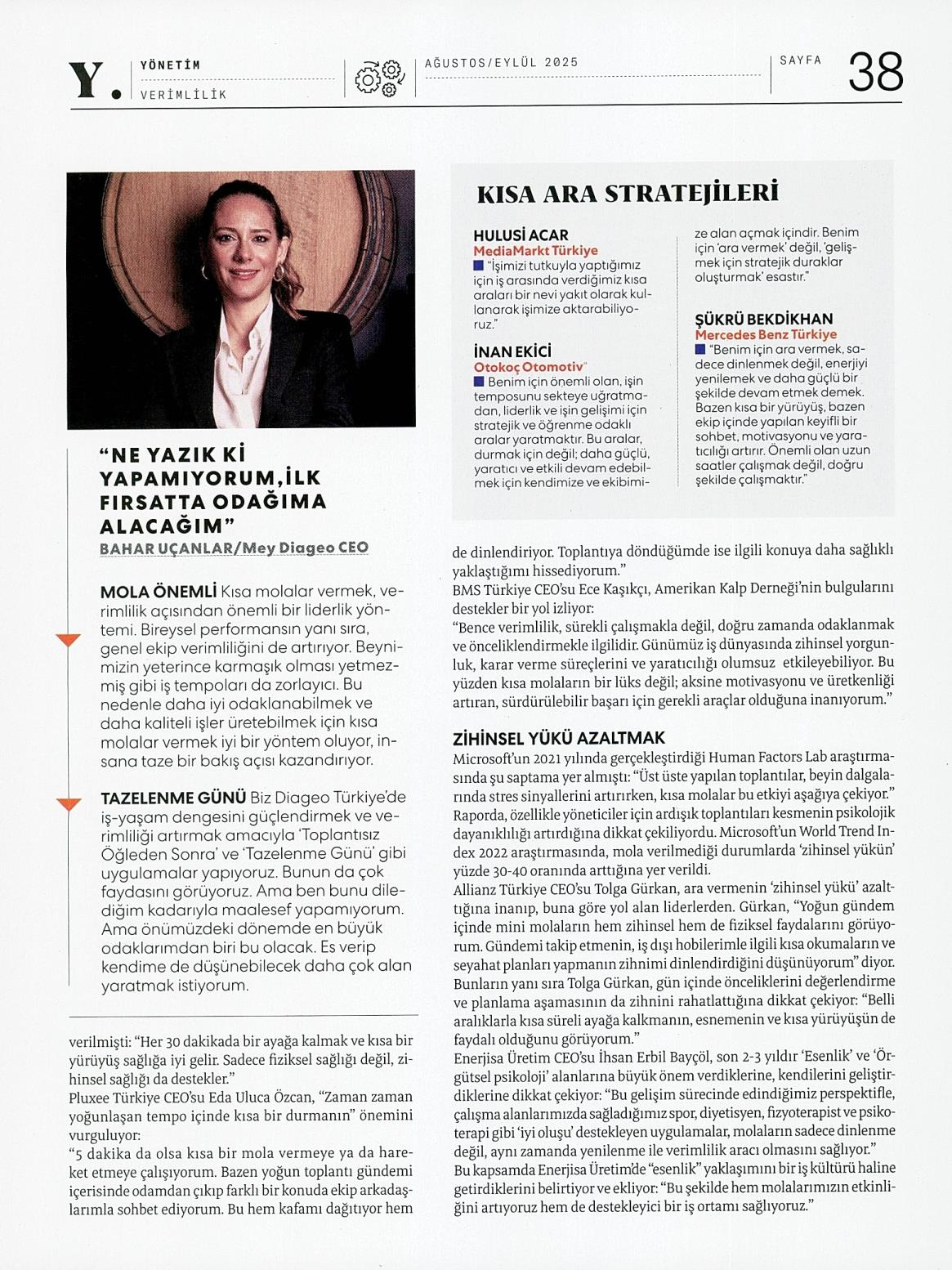
REFRESHMENT DAY: We at Diageo Turkey implement practices such as "Meeting-Free Afternoon" and "Refreshment Day" to strengthen the work-life balance. But unfortunately, I cannot do this as much as I wish. This will be one of my biggest focuses in the coming period.
HULUSİ ACAR (MediaMarkt Turkey): "Since we do our job with passion, we can use the short breaks we take between work as a kind of fuel and transfer it to our work."
İNAN EKİCİ (Otokoç Otomotiv): "For me, the essential thing is not 'taking a break,' but 'creating strategic stops for development.' These breaks are not for stopping, but for opening space for ourselves and our team to continue stronger, more creative, and more effective."
ŞÜKRÜ BEKDİKHAN (Mercedes Benz Turkey): "For me, taking a break means not just resting, but renewing energy. What matters is not working long hours, but working in the right way."
In the Human Factors Lab research conducted by Microsoft in 2021, the following finding was included: "Back-to-back meetings increase stress signals in brain waves, while short breaks pull this effect down."
Tolga Gürkan, CEO of Allianz Turkey, is among the leaders who believe that taking a break reduces the "mental load" and proceeds accordingly. Gürkan says, "I think that following the agenda, short readings related to my non-work hobbies, and making travel plans rests my mind."
İhsan Erbil Bayçöl, CEO of Enerjisa Üretim, states that they have turned the "Well-being" approach into a work culture: "Practices such as sports, dietitians, physiotherapists, and psychotherapy that we provide in our workspaces ensure that breaks are not just resting, but also a tool for renewal and efficiency."